
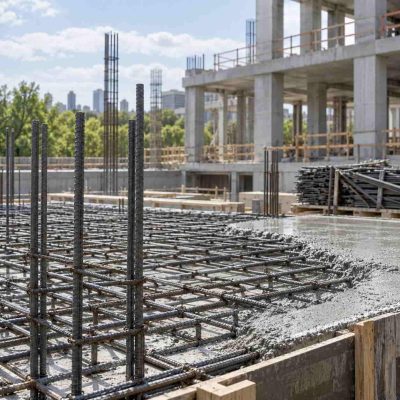
 Concrete is one of the most widely used construction materials worldwide. It supports buildings, bridges, roads, tunnels, drainage systems, and other essential infrastructure. However, concrete performs much better under compression than under tension. When structures bend, stretch, or experience heavy loads, unreinforced concrete can crack or fail.
Extending the Lifespan of Concrete Structures
One of the most important environmental benefits of steel reinforcement is its ability to extend the service life of concrete structures. Reinforced concrete can withstand heavier loads, movement, vibration, and changing environmental conditions. Properly designed steel reinforcement helps control cracking and reduces the risk of premature structural failure. This allows buildings and infrastructure to remain functional for decades.
Longer-lasting structures generally require fewer replacements. Replacing a damaged building, bridge, or concrete slab involves producing new materials, transporting them to the site, operating construction equipment, and managing demolition waste. By delaying or avoiding replacement, reinforced concrete can reduce the environmental impact associated with repeated construction. Durability is especially valuable for large infrastructure projects, where reconstruction can consume substantial amounts of raw materials and energy.
Supporting the Use of Recycled Materials
Steel is highly recyclable. Steel can be manufactured from scrap recovered from old vehicles, appliances, buildings, industrial equipment, and demolished infrastructure.
Many steelmaking facilities use electric arc furnaces to melt scrap steel and turn it into new products, including reinforcement bars. This process keeps existing materials in circulation instead of discarding them. The recycled steel can also be recycled again at the end of a structure’s useful life without losing its essential mechanical properties.
Using recycled steel reduces demand for newly mined iron ore and can limit some of the environmental disruption caused by extracting and processing virgin raw materials. It also helps divert metal waste from landfills.
The amount of recycled content and the emissions produced during manufacturing vary among suppliers. For this reason, contractors and developers can improve environmental performance by selecting reinforcement from manufacturers that disclose their recycled content, energy sources, and production emissions.
Improving Material Efficiency
Steel reinforcement lets engineers design concrete components that carry greater loads without relying on larger volumes of concrete. In some applications, a well-designed reinforced concrete element can be thinner or more efficient than an unreinforced alternative. Engineers can design columns, beams, slabs, and walls to provide the required strength while using materials more strategically.
This does not mean that adding steel automatically reduces the amount of concrete in every project. Structural requirements, safety standards, exposure conditions, and building codes still determine the necessary dimensions. Nevertheless, reinforcement gives engineers greater flexibility to optimize material use.
Reducing Repair and Maintenance Requirements
Cracks in concrete can allow water, salts, chemicals, and other damaging substances to enter a structure. Over time, this can contribute to deterioration and create a need for frequent repairs.
Properly placed reinforcement helps manage cracking and distribute stresses across the concrete. When combined with suitable concrete cover, careful mixing, correct installation, and effective drainage, steel reinforcement can help a structure perform reliably for longer.
Fewer major repairs can mean lower consumption of cement, aggregates, coatings, replacement steel, and other construction products. It may also reduce the fuel used by repair vehicles and heavy machinery.
The environmental benefit depends on controlling corrosion properly. If poor design or artistry exposes reinforcement to moisture and chlorides, corrosion can cause the surrounding concrete to crack or spall. Durable construction therefore requires appropriate reinforcement selection, adequate concrete cover, quality installation, and maintenance suited to local conditions.
Enabling Adaptable and Resilient Structures
A structure that can withstand demanding conditions is less likely to require complete demolition after damage or changes in use. Steel-reinforced concrete can be designed to resist wind, earthquakes, impact, fire, and heavy operational loads.
This resilience can provide environmental value in areas exposed to natural hazards. If a structure remains usable or repairable after an extreme event, reconstruction may require fewer materials.
Reinforced concrete buildings may also be adapted, renovated, or strengthened to support new uses.
Reusing an existing structure is often less resource-intensive than demolishing it and building an entirely new one. Steel reinforcement can help provide the strength and flexibility needed for these long-term adaptations.
Supporting Resource Recovery After Demolition
When a reinforced concrete structure reaches the end of its useful life, you can recover its primary materials. Concrete can be crushed for use as recycled aggregate, road base, or fill, depending on its condition and local regulations. Mechanical equipment and magnets can separate the embedded steel before sending it to a recycling facility.
This recovery process supports a more circular approach to construction. Instead of treating an entire demolished structure as waste, contractors can separate its components and return useful materials to the supply chain.
Designing structures with future dismantling and material recovery in mind can improve this benefit. Accurate records of reinforcement layouts, material specifications, and possible contaminants can make eventual recovery more efficient.
A Life-Cycle Approach Is Essential
Steel reinforcement is not environmentally impact-free. Mining, steelmaking, transportation, and fabrication all consume energy and produce emissions. Its environmental advantages should therefore be evaluated across a project’s full life cycle.
The best outcomes usually come from combining efficient structural design with low-carbon concrete, responsibly produced reinforcement, local sourcing, durable construction, and plans for eventual recycling. Engineers may also use environmental product declarations to compare the impacts of available materials.
Steel reinforcement can make concrete structures stronger, longer-lasting, more adaptable, and easier to recover at the end of their service life. When selected and installed responsibly, it can help the construction industry reduce waste, conserve resources, and create infrastructure that delivers value for generations.
Category: